As Gertrude sat at her desk in the summer of 1943, an all-too-familiar scene unfolded. Parents had come to her office to enroll their five-year-old daughter, Amanda, in kindergarten. But Amanda had Down syndrome, and the public school system couldn't meet her needs. So Gertrude could only offer the family two options: keep Amanda at home without access to a formal education or send her to a distant institution where she would be separated from her family and segregated from her peers. The parents nodded slowly, trying to process Gertrude's words. The mother wiped away a tear. And they left the office feeling alone and unsure what to do next.
Committed to Finding a New Path. Gertrude worked as the Erie, Pennsylvania, School District's home and school visitor; it was part of her job to meet with families who had children with intellectual disabilities. But the result was often the same: their children couldn't be helped by the public school system. It broke her heart. It was her job to educate children—all children! Those with special needs were sons and daughters of God just like anyone. They had dignity and deserved the chance to flourish, to reach their full potential. What can I do? Gertrude asked herself.
In the 1930s, when Gertrude began her teaching career, there wasn't much sympathy for people with intellectual disabilities. Because they didn't look or behave like other children, many people thought that they were best left on the margins. It was certainly unheard of that children with disabilities could be educated and reside in their own communities. But Gertrude couldn't accept that these precious children would be pushed to the side. She was determined to find another way!
Passionate about Education from the Beginning. Gertrude Barber was born in 1911, in Erie, Pennsylvania—the seventh of ten children in an Irish Catholic family. She attended Catholic elementary and high school and was a member of the same parish her entire life. Her parents instilled in their children the ideals of faith, family, and service to other people. Tragically, in 1918, her father passed away during the influenza epidemic. Gertrude's eldest brother left school to support the family and to enable his siblings to continue their education. His sacrifice, combined with Gertrude's strong Catholic upbringing, had a profound impact on her.
Gertrude graduated from college in 1931 with a degree in elementary education, and she was ready to change the world. But because jobs were scarce during the Great Depression, her first job was as a substitute elementary teacher with the Erie School District. It might have been a disappointment for this motivated teacher who wanted to make a difference in the lives of her students. But a school administrator told her that she didn't need to go far to make a difference. She could do that right in her community by helping the special needs children in the school system. So in 1933, Gertrude became a full-time special education teacher.
A decade later, she was appointed home and school visitor. It was in that capacity that Gertrude confronted the anguish and frustration that parents of children with disabilities felt when it came to pursuing an education for their children. And in 1945, after earning a master's degree in psychology, she was appointed coordinator of the district's special education programs.
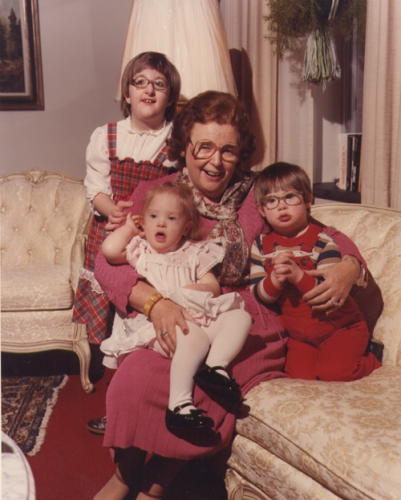
Driven by Deep Faith and Compassion. Because she saw all persons as children of God, Gertrude set to work, trying to see what she could do to provide for these students and their families. She took them into her heart, and as she shared in their pain, she was compelled to help. As one mother said, "We were her family; our children were her children, and we could pretty much talk to her about anything."
In 1952, with not much more than a smile and a prayer, Gertrude borrowed a room from the local YMCA and opened the first class for students with intellectual disabilities, as well as children with vision and hearing impairment. Over time, she opened more community sites to provide preschool classes for children and job skills workshops for adults. She had a way of getting people on board with her—soliciting meeting space from local organizations and recruiting teachers. As those who worked with her often said, you just couldn't say no to Ms. Barber. She was driven to serve and to get you to serve alongside her.
But Gertrude wanted to do more. She continued her own education and earned a PhD in education in 1956. And when the Erie School District leased the former Lakeview Hospital, Dr. Barber took on the task of converting the building into a special education school and adult workshop. Gertrude didn't want it to feel like an institution, with four walls and a fence around it. So she turned it into a one-of-a-kind place where special-needs students and their families could take classes and receive services. At a time when such schools were almost nonexistent, it was a first step in providing integrated, individualized, and community-based care for individuals with disabilities.
As Cathy Crawford, whose daughter Norah was served by the Barber Center, says, "Dr. Barber was always there to compassionately guide families through the darkest hours. She guided us through trying times and brought us to a much higher level by allowing us to find some reason for our experience, and then to put it to good use in assisting others. Dr. Barber . . . delivered every individual she encountered to a place that can only be described as their personal best."
More Work to Be Done. In 1963, the Dr. Gertrude A. Barber Center was designated an approved private school by the Pennsylvania Department of Education. In 1971, Dr. Barber retired after 37 years with the Erie School District to devote all her attention to the children she loved so much. That same year, the school district deeded the land and former hospital to the Barber Center. It seemed a fitting result after all the times that, as Gertrude admitted, she and her mother buried medals on the grounds with a prayer that the land would be given to the Barber Center!
In the following three decades, Dr. Barber's unstoppable drive to improve the lives of people with intellectual disabilities bore great fruit. The Barber Center expanded to multiple locations throughout Pennsylvania. She developed services that spanned a person's lifetime, including preschool and early intervention services for infants and toddlers, group homes and adult day services, and a center for adults in their senior years. She was convinced that her mission was a way for the entire community to grow closer to God through service to the vulnerable.
Dr. Gertrude Barber passed away in 2000. During her life, she received many awards and recognition. She served on a White House task force under President Kennedy on the education of persons with intellectual disabilities. She contributed to the writing of the Americans with Disabilities Act and traveled to Washington, DC, when President George H. W. Bush signed it into law in 1990. She received many local and national honors. But the title dearest to her heart was "teacher."
Faith in Action. Gertrude's faith came alive through service. Her love for the Lord called her—as it calls us—to love and serve other people. Bishop Edward M. Lohse of Kalamazoo said that Barber's "life and witness call us to remember and honor the presence of Christ, even in the most vulnerable of our brothers and sisters, and to see reflected in them the beauty of a loving Creator." Monsignor Robert Goodill called her the "Mother Teresa of Erie" and said, "She saw the suffering of the exceptional children and adults of this area and used her manifest skills and, above all, her love to respond."
Gertrude's niece, Maureen Barber-Carey—currently executive VP of the Barber National Institute—adds, "She truly believed she was a servant of God and that she was doing God's work on earth. It was to have persons with disabilities acknowledged—that they were children of God, just as a person without a disability is, and as a child of God, they deserve every right to have every opportunity to be the best they can possibly be."
People who knew and worked with Dr. Barber formally appealed to Bishop Lawrence Persico of the Diocese of Erie to begin the cause for canonization. The cause for Servant of God Gertrude Barber was opened by the Diocese of Erie in December 2019.
Barber's Work Continues to Change Lives. Dr. Barber's passion for children with disabilities changed lives and is still changing lives. Today, special-needs children are much more likely to be integrated into their communities. Parents receive early intervention for their children and support for themselves. Their children are educated in their local school districts and receive supplemental training and enrichment. One of the best-known places where this happens nationwide is the Barber National Institute.
Today, the Barber National Institute serves more than 7,300 children, adults, and their families at their main campus and at multiple satellite locations. They provide care for children from twenty-four area school districts, as well as adult training and job placement services, group homes and recreational programs, a retirement center for adults in their senior years, and mental health support services. They welcome individuals with autism, intellectual disabilities, and behavioral health challenges.
Dr. Gertrude Barber expanded the horizons of hundreds—if not thousands—of children. But she also taught a community and a nation how to ensure better, more enriching lives for individuals with disabilities. She would say, "In making someone else's life better, I make my own life better." She shows us how to look at people with the loving eyes of Jesus and to treat them accordingly.
But the work isn't done. And if you listen closely, you might hear her urging you with the message she proclaimed to everyone she met: "Almighty God says, 'Disabled individuals are truly my children, leading the way to heaven.' You'd better get on the bandwagon so you can get there, too!"
Hallie Riedel writes from Frederick, Maryland.
Correction: Barber National Institute serves 5,400 children and adults with intellectual disabilities and autism and their families.